
Grand County Civil Docket Searches
Grand County District and Justice Court cases are online. Utah Courts Xchange is the tool to use. Nearly all civil matters in the county go to Seventh District Court at Moab. Small claims are the exception. The Grand County Justice Court hears those when it has territorial jurisdiction. Check the filing notice or court name first. A paid search in the wrong court wastes money.
A case number is the fastest way in. Without one, narrow by county and court, since Utah numbers are not unique statewide. For a person, type Last Name/Company and First Name. Use the wildcard trick, like Doe*. Business names go in the Last Name/Company box. Before you open a case history, confirm the court, case type, filing date, party code, and case number match what you expected.
- Select District Court for an ordinary civil, domestic-relations, or probate case. Select Justice Court for a small claim.
- Limit Search Scope to Grand County or the Moab court, then enter a case number or party name.
- Choose a civil case type or date range if the result set is broad. Xchange displays no more than 500 results.
- Open Case History/Documents and review parties, attorneys, proceedings, hearings, and judgment entries.
- Use the court clerk for an unavailable filed paper, certified judgment, transcript, or other official record.
Grand County Civil Search Controls
The official Xchange help material lays out every search control. It also shows sample case-history fields for a Grand County civil docket search.
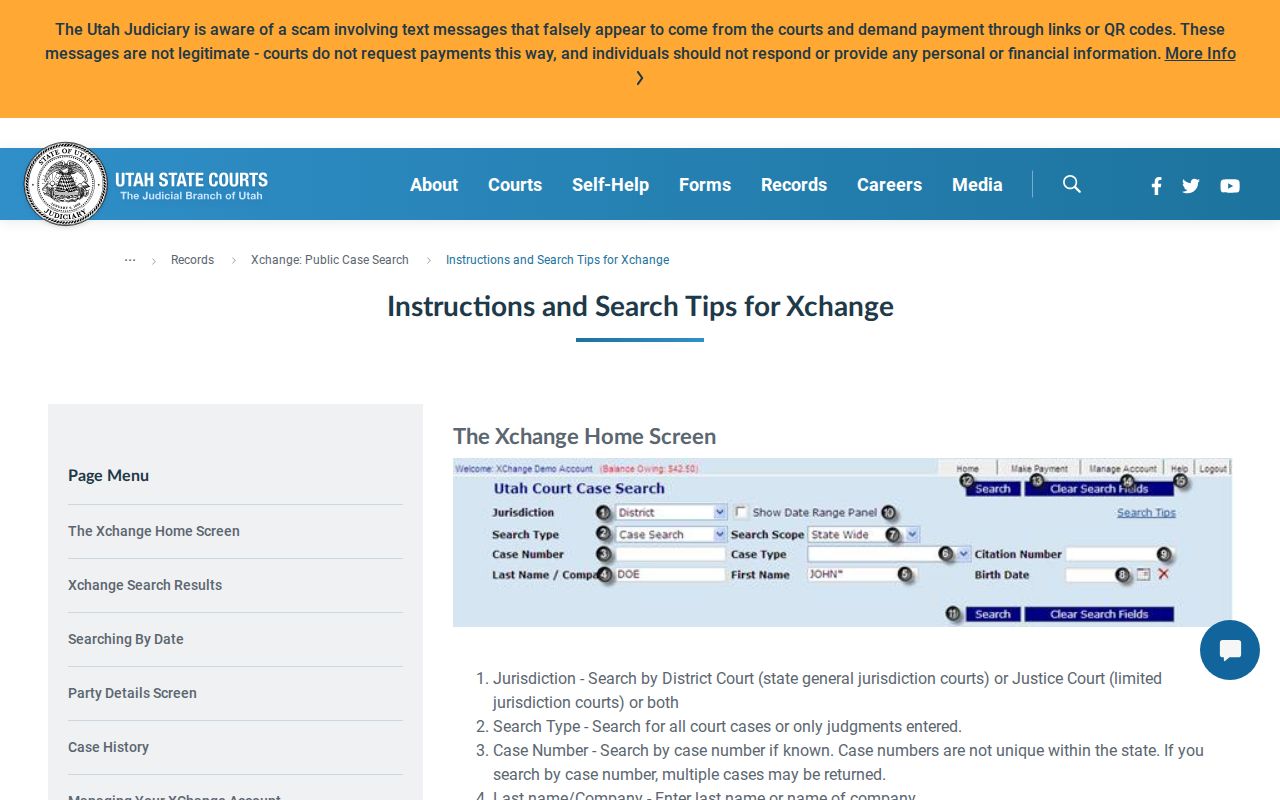
The controls explain why narrowing first pays off. Every Search click is billable. Search Type can cover all cases or judgments only. Search Scope can be statewide, countywide, or a single court, and the date panel can target filing, case disposition, judgment entry, or judgment disposition.
| Search field | Best Grand County civil use | Important limit |
|---|---|---|
| Case Number | Known District or Justice Court file | Not unique statewide |
| Last Name/Company | Person surname or business party | Use a trailing wildcard for variants |
| Case Type | Contract, debt, tort, probate, domestic, or small claims | Select the correct court with it |
| Search Scope | Grand County or Moab location | Statewide scope can be too broad |
| Date Range | Filing, disposition, or judgment period | Dates describe different events |
Civil Dockets: What They Show
A Grand County civil docket starts with the basics. The result opens with county, court location, case type, number, filing date, party names, and party codes. Expanding it adds the style of the case, the assigned judge, parties, attorneys, proceedings, hearings, judgments or outcomes, document due dates, and account data. The proceedings are what give the record its dated spine.
You will see entries like a complaint or petition, summons, answer, motion, opposition, notice, hearing, order, judgment, satisfaction, appeal, or due date. Whatever term appears is the clerk’s own entry. Keep one limit in mind. An entry labeled Judgment does not guarantee that the signed judgment image is free or open online.
| Case Number | The court-location identifier; add Grand County scope because it is not unique statewide. |
|---|---|
| Parties | Plaintiff, defendant, petitioner, respondent, and other roles as the case requires. |
| Proceedings | The date-ordered record of filings, notices, motions, hearings, rulings, and later events. |
| Documents | Available public images may have a Purchase link; other papers require the clerk. |
| Judgment | The entered result, which must be distinguished from the full signed record. |
Grand County Small Claims Docket
Small claims are the one civil case type that skips the District Court route. Utah’s Small Claims information sends a claim to a justice court with territorial jurisdiction over the dispute. Grand County Justice Court’s official scope confirms small claims are the civil cases it takes. In Xchange, ordinary small claims carry the code SC. A small-claims trial de novo appeal shows ST.
An appeal does more than update the old docket. Utah Code gives District Court appellate jurisdiction over justice judgments and small-claims appeals. The appeal creates a brand new District Court matter. Following it may take a second search under District Court jurisdiction. Confirm the new case number and court location with the clerk.
| Feature | Most Grand County civil cases | Small claims |
|---|---|---|
| Starting court | Seventh District Court, Moab | Grand County Justice Court |
| Xchange jurisdiction | District Court | Justice Court |
| Appeal path | State appellate route as law assigns | New District Court proceeding |
What Cases Fill the Civil Docket
The Seventh District Court’s Grand County civil docket spans contracts, debt collection, property rights, torts, civil stalking, writs, probate, and domestic-relations categories. Xchange separates them with short case-type codes. You might run into CN for Contracts, DC for Debt Collection, EV for Eviction, or PR for Property Rights. TA is Automobile Tort.
Probate codes include ES for Estate Personal Representative. GT is for Adult Guardian, and NC for Name Change. On the domestic side there are DA for Divorce/Annulment and PO for Protective Order. A code helps you find the right docket fast. Access to the papers behind it still depends on how the case is classified.
- Contract, fraud, debt, lien, and judgment matters
- Property rights, eviction, condemnation, and water-rights matters
- Automobile, intentional, premises, product, and other tort cases
- Divorce, custody, support, paternity, and protective-order cases
- Estate, guardianship, conservatorship, trust, and name-change cases
Grand County Civil Docket Mix
The FY2013 Moab District Court report is dated material. Treat it as context rather than a forecast of today’s Grand County civil docket. It shows the civil docket was far from evenly split among case types. Debt collection alone accounted for 205 filings and 222 dispositions. The same report listed 45 divorce or annulment filings. It also showed 47 protective-order filings, 30 probate filings, and 13 property-rights filings.
Across all district case types that fiscal year, Grand County District Court reported 547 filings and 583 dispositions. The overall clearance rate was 107 percent. Those totals sweep in more than civil cases. They also cannot predict a current wait time or volume. Their real value is narrower. A party-name search in the Moab District Court system may need a case-type filter. Many kinds of civil and domestic matters share the same court.
Hearings on the Civil Docket
A Grand County civil docket line can tell you a hearing happened or was set. But it is not always current on the next date. For that, use the Utah District and Justice Court calendar, which covers a rolling two-week window. It refreshes daily. Each entry lists the court, date, time, case number, party names, judge, and hearing type.
Always trust the newest setting. Old hearings linger in the history after a continuance or reset. If a mailed notice and the online calendar disagree, call Seventh District Court at 435-259-1349, or Grand County Justice Court at 435-259-1334 for a small claim. Ask whether a later order, a new setting, or a remote-hearing instruction now controls. The Seventh District Digital Evidence Plan and Remote Hearing Requirements took effect July 1, 2025. None of that confirms the date for you.
Filing and setting are different things, too. A motion may sit in Proceedings with no hearing date attached. A scheduling order can set several deadlines at once. One judgment entry can end some claims while leaving others alive. When scope matters, read the order behind the event.
Grand County Signed Civil Judgments
A docket line is one layer. The official document is another. Xchange may offer a public image through a Purchase link for $1 per document. If no image appears, contact Loni Page’s Seventh District Court clerk office. Or file through the Request for a Court Record process. Looking at a record is free. The usual response target is ten business days.
Copies cost more. A certified copy runs the statewide fee of $4 per document plus $0.50 per page. An exemplified copy is $6 per document plus $0.50 per page. Paper copies run $0.25 per sheet. Staff time may be charged after the first 15 minutes. Confirm the current fee and the exact certification type with the clerk before you order.
You can also walk in. The clerk counter sits at 125 E. Center Street, Moab. Public Xchange terminals are free at most district courthouses. A written request may go by mail. For record and scanning questions, use moabscan@utcourts.gov. Under the October 2024 rural-access order, self-represented pleadings may be emailed as PDFs, mailed, scanned in the lobby, or dropped in the secure dropbox. Never put money in that box.
A party who needs authorized access to a personal civil case can turn to MyCourtCase. Eligible users can see case history, filed papers, payments, and linked cases. That is a different layer from the public Xchange search. It does not change whether a record is public, private, protected, or sealed.
Who Can See Civil Dockets
Most Utah court records are open. Yet a Grand County civil docket can mix public history with private papers. Domestic relations, protective orders, guardianships, custody and support, and parentage records may all be private. Still, the case history, public-hearing record, judgment, order, decree, or letters of appointment can stay public. A judge can restrict them. Adoption and civil-commitment matters may be sealed outright.
The Utah court-record classification rule explains why an online search can never substitute for an actual access decision.
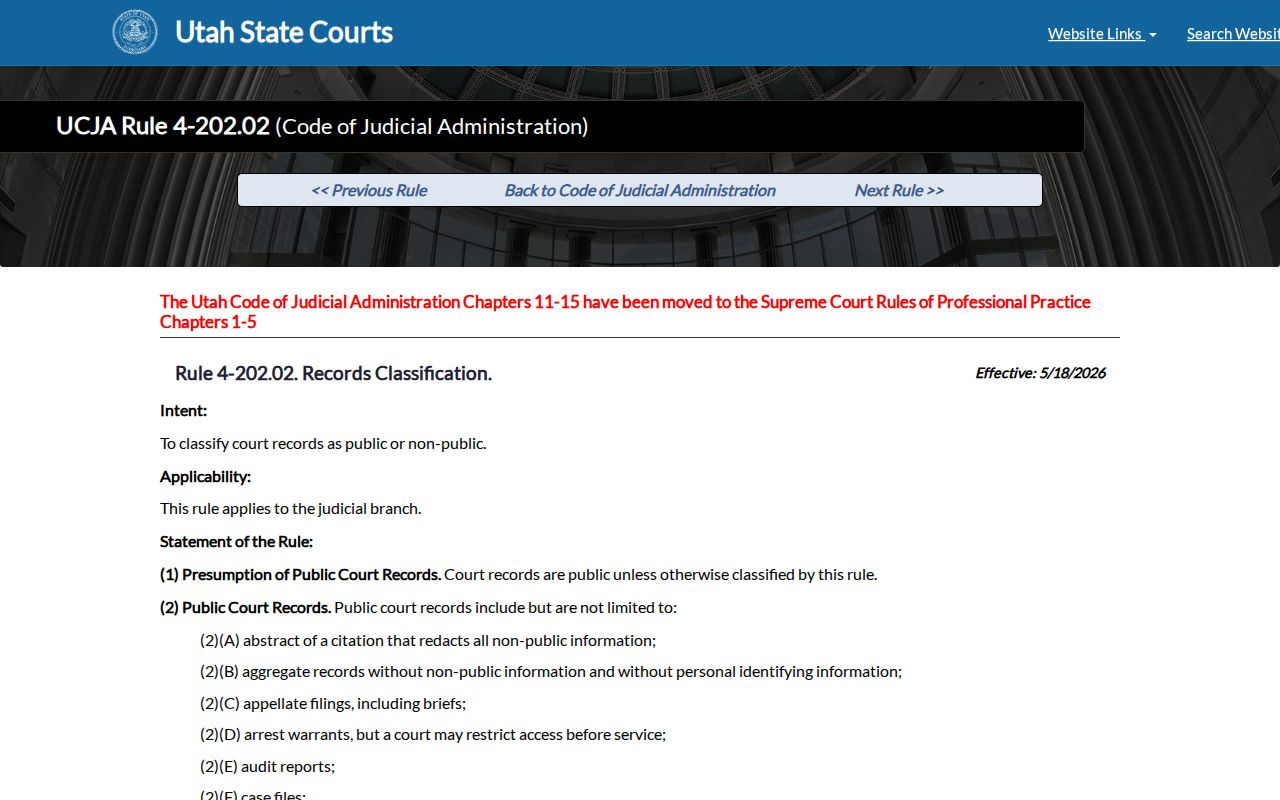
Under the rule, every record is classed as public, private, safeguarded, protected, or sealed. The label attaches to the record itself, not just the case name. Anyone asking for non-public material must state the basis for entitlement on the court’s written form.
Access boundary: A public case-history entry does not make every linked pleading, exhibit, medical record, or family filing public. Verify access with the court that maintains it.
Grand County Civil Record Custodians
Two different clerks hold Grand County civil records. The District Court clerk keeps most civil, domestic, and probate dockets. The Justice Court clerk keeps small claims. The Grand County Clerk/Auditor is clerk of neither court. County and court offices share the courthouse, but that does not change the split. A county GRAMA request fits county-held administrative records, not a District Court case file.
The Sheriff Civil Unit is separate as well. It handles service of process and court-ordered execution work at 25 S. 100 E. Its public line is 435-259-8115. It does not keep the civil docket. A return of service may show up later as a filed event. But the docket and official file stay with the court clerk.
So route your Grand County request correctly. For a District Court matter, call 435-259-1349. Or write to moabscan@utcourts.gov for the record and scanning route. For a small claim, call Grand County Justice Court at 435-259-1334. Or email jcmoab@utcourts.gov. Knowing the split is the fastest path to a Grand County civil court record.