
Grand County Court Record Requests
Which court heard the case? That answer decides where the file lives. The Seventh District Court clerk holds Grand County felony, Class A misdemeanor, ordinary civil, domestic-relations, probate, judgment, and order files. Justice Court files are separate. They cover traffic, parking, infraction, Class B and C misdemeanor, ordinance, river-runner safety citation, and small claims. The elected Grand County Clerk/Auditor is clerk of neither court. That office cannot certify their case files.
For public case information, check Utah Courts Xchange. Most district courthouses offer a free public Xchange terminal. The Justice Court can confirm its own terminal access. Beyond that, a person can inspect a public file at the counter, call the clerk, mail or email the statewide form, or drop paper filings in the secure courthouse dropbox. Material already in Xchange will not be faxed or emailed.
- Match the case to District Court or Justice Court and gather the case number, party names, and filing date.
- Check Xchange for a case history or an available document before asking staff to search.
- For an in-person inspection, visit the correct court counter at 125 E. Center Street in Moab.
- For a remote request, complete the Utah Request for a Record form and send it to the court holding the file.
- State whether inspection, a plain copy, certification, exemplification, audio, or a transcript is needed, then pay the quoted charge.
Grand County Record Request Form
When a summary is not enough, the Utah Courts record-request instructions walk you to a two-page form for anything Xchange cannot deliver. The form asks who you are. It also asks what record you want, which court likely holds it, and whether you want to inspect it or receive a copy. There is also space to claim a right to non-public material, request a fee waiver, or support an expedited response.
Expect an answer within ten business days. Along the way the court may ask for clarification, estimate staff time, or want payment first. Expedited handling under Rule 4-202.06 requires a supported public-benefit or media basis. Filing the form does not unseal a sealed record.
The official page shows the path. It runs the Grand County court case record request from start to finish.
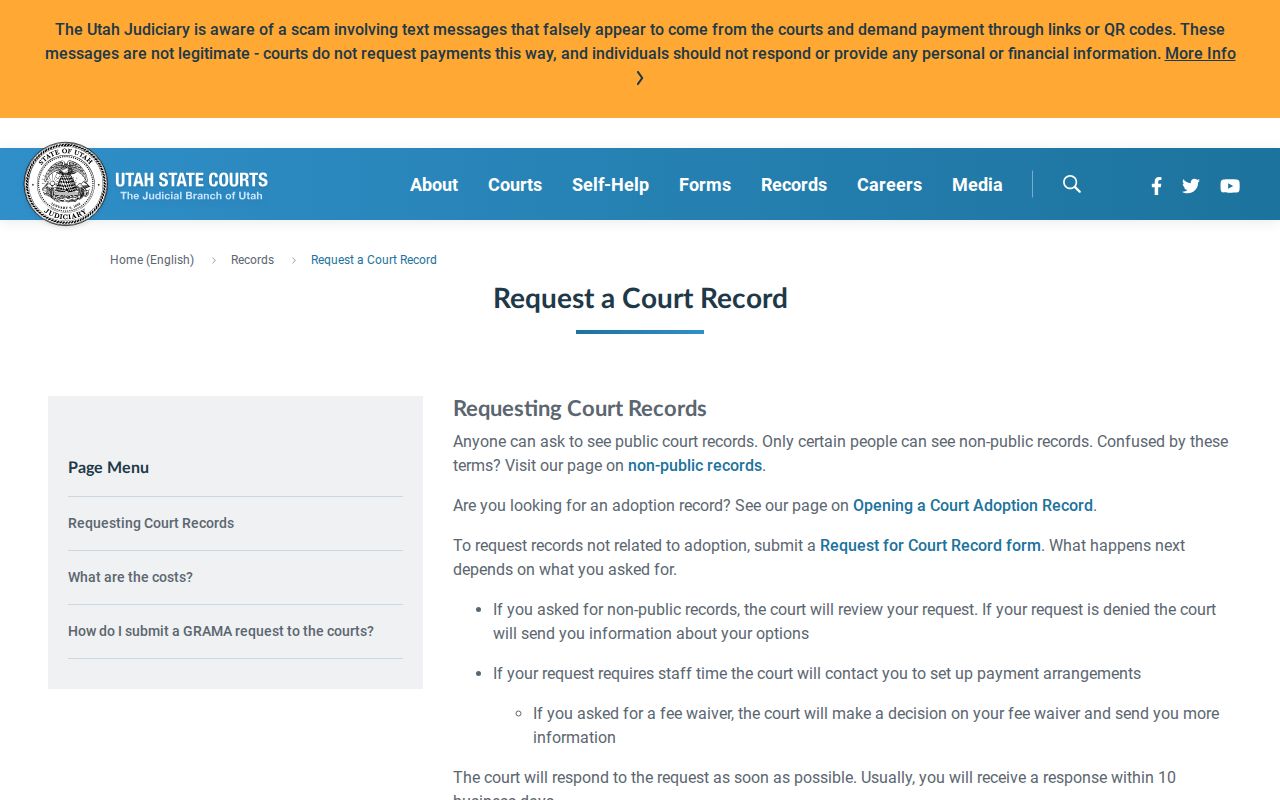
The official instructions draw one key line plainly. Inspection may be free, while copies, staff work, and certification can cost money.
Kinds of Grand County Court Records
A docket is only the top layer. It gives the case header plus a dated list of proceedings. Underneath sits the full file. That means complaint or petition, answer, motions, notices, public exhibits, signed orders, judgments, and decrees. A criminal docket file can show charges, pleas, and outcomes. Probate files may hold letters of appointment. Utah privacy rules limit some probate and domestic material, though.
- Search results with county, court, case type, number, filing date, and party information
- Case histories with proceedings, hearings, outcomes, and accounting entries
- Filed pleadings, motions, notices, public exhibits, signed orders, and judgments
- Official audio or video records and separately prepared transcripts
- Plain, certified, or exemplified copies supplied by the responsible clerk
Coverage is uneven. District Court documents filed electronically since July 1, 2010 may sit in Xchange. It depends on case type. Moab District Court joined statewide coverage on July 30, 1996. Older converted files and Justice Court histories can be thinner.
Two Grand County Record Clerks
One building, two clerks. District and Justice Court staff share a courthouse. They keep separate files and phone lines, so a wrong-counter request happens easily. The District Court directory lists Loni Page as Clerk of Court. For the Justice Court, Emily Butterfield is Chief Deputy Court Clerk. Marsha Humphreys is Senior Court Clerk. Roles shift over time, so confirm names in the current directory.
Grand County Justice Court Clerk
125 E. Center Street
Moab, UT 84532
435-259-1334
The official Grand County directory identifies the District Court location and its public contacts.
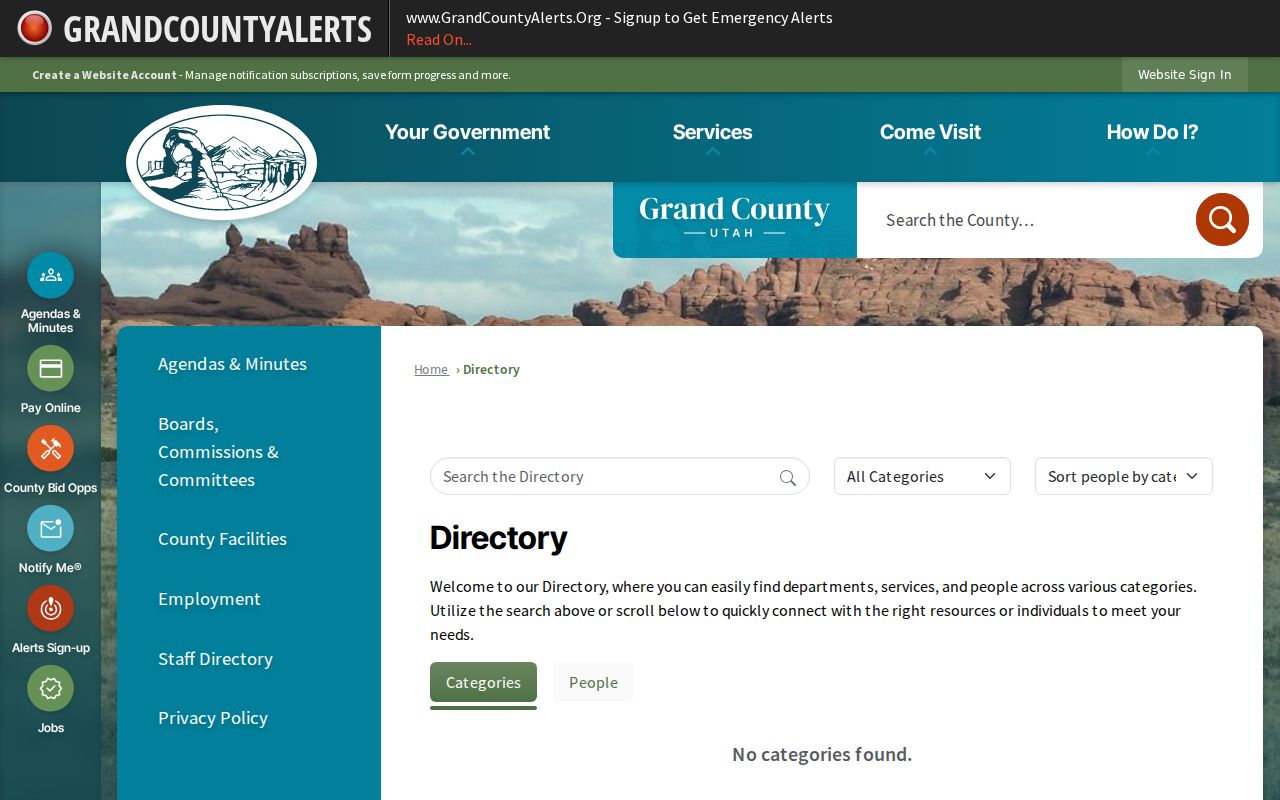
District Court scanning and recording requests go to moabscan@utcourts.gov; Justice Court case questions go to jcmoab@utcourts.gov.
Grand County Records: What They Contain
A case number identifies one file at one Utah court location. It is not unique statewide. So county and court location matter. The case history lists events in date order, while a document link opens an image. An entry saying an order was entered does not show the signed order itself.
| Case header | Grand County, court, case type, filing date, case number, style, and judge. |
|---|---|
| Parties and counsel | Names, public party-role codes, and attorneys. |
| Proceedings | Filings, hearings, minute entries, pleas, judgments, and dispositions. |
| Filed papers | Complaints, petitions, answers, motions, notices, orders, judgments, and public exhibits. |
| Account data | Public fine, fee, payment, and balance entries. |
| Media | Official audio or video and a separately ordered transcript. |
With a known number, search the Grand County or Moab court scope. A name match alone proves little. The Grand County docket search lays out the detailed workflow.
Moab Court Audio and Transcripts
Utah trial courts capture proceedings mainly as digital audio. For an official Grand County recording, email moabscan@utcourts.gov. The state transcript instructions separate a recording from an official written transcript. An assigned transcriber prepares the transcript. Payment gets arranged, and certified paper and PDF versions are filed with the trial court.
A transcript prepared by anyone else is not official for court use. That distinction matters on appeal. It also matters whenever the words spoken at a hearing must be established. Name the case, date, and proceeding as precisely as you can.
Note: A docket entry describing a hearing cannot replace its official recording or certified transcript.
Copy Fees and Certification
Copies come in three grades. A plain copy just reproduces the record; a certified copy adds the clerk's certification; an exemplified copy carries a higher form of authentication. The Utah Courts fee schedule lists the statewide charges, and the clerk can confirm the service and any staff time involved.
| Grand County court record item | Amount |
|---|---|
| Inspection | Free |
| Paper copy | $0.25 per sheet |
| Fax or email | $5 for 10 pages or less; $0.50 per page after |
| Audio or video | $15 per half-day of testimony |
| Certified copy | $4 per document plus $0.50 per page |
| Exemplified copy | $6 per document plus $0.50 per page |
| Initial certified transcript | $6 per page |
The official fee display illustrates certification choices for Grand County court case records.
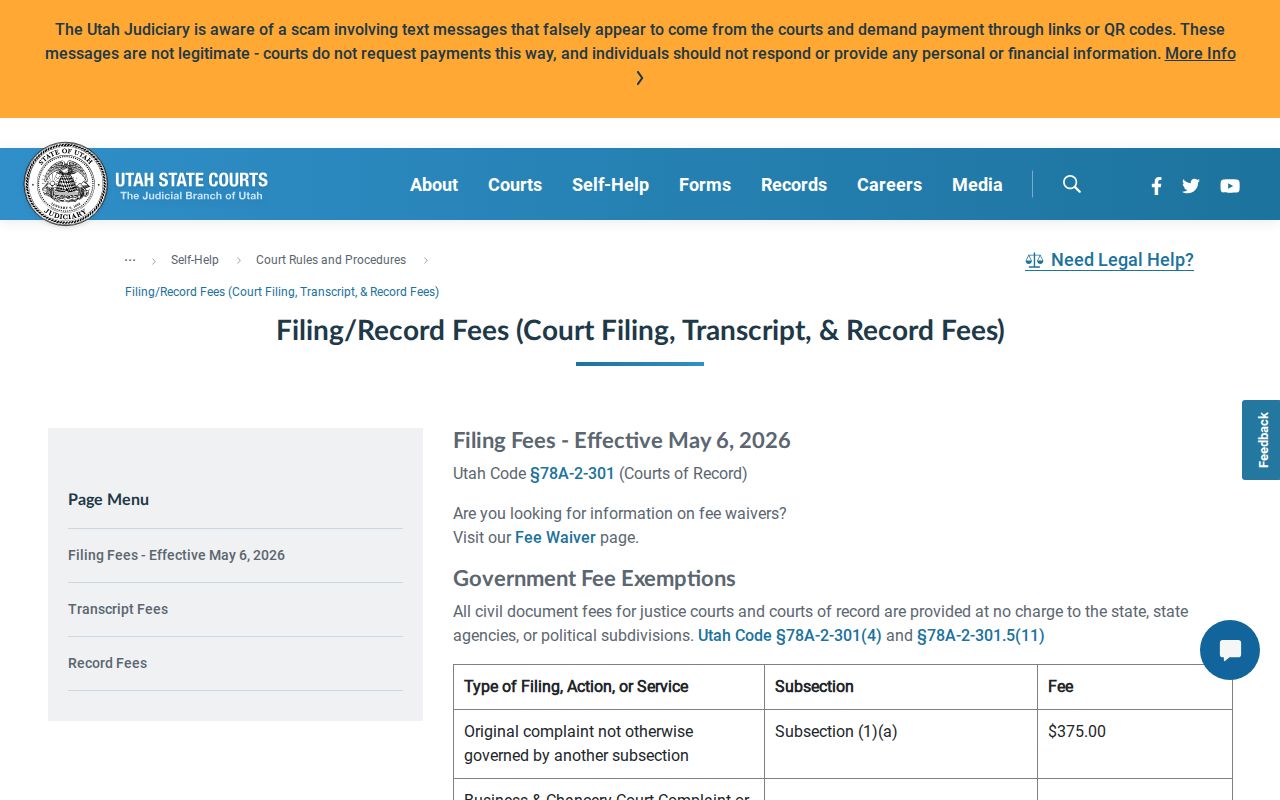
Staff time has a grace period. The first 15 minutes of preparation are free. Work beyond that can be billed at the rate of the least costly qualified staff member.
Xchange Is Not Certification
An Xchange image runs $1 per document when one is available. That price holds no matter how many pages it holds. Treat that download as a working copy. It is not a certified Grand County court record, and it never will be. Xchange pulls from CORIS entries that Grand County court staff make. So public proceedings show up quickly. What it cannot do is certify an image or reveal non-public material.
For everyday reading, Xchange is fine. When a receiving office or a formal process needs authentication, ask the clerk for certification. Exemplification is the other option there. The clerk can also tell you whether an older file lives only on paper.
Access Rules for Court Records
Utah court records answer to the Utah Code of Judicial Administration. They do not answer to the county administrative-record portal. Rule 4-202.02 opens with public access. A record stays open unless something classifies it otherwise. Private records go only to parties, lawyers, and people with authorization. Protected records can cover attorney work product and court security plans. Sealed records include adoption and expungement matters. They generally need a court order before anyone sees them.
Utah court-record rules:
UCJA Rule 4-202.02 classifies court records as public, private, safeguarded, protected, or sealed.
UCJA Rule 4-202.08 governs copy and staff-time charges.
Utah GRAMA recognizes judicial records while leaving restrictions to court rules.
Domestic, protective-order, guardianship, victim, medical, and fee-waiver material can be private even when parts of the case history stay public. Juvenile cases do not travel through Xchange as ordinary public matters. And a missing result is not always a mystery. It can reflect expungement, an old conversion, or simply the wrong court.