
How the Grand County Court Calendar Works
Every setting in the county flows through the Utah Courts District and Justice Court calendar. That official service refreshes daily and shows a two-week window of scheduled activity. It covers the Seventh District Court location in Moab along with Grand County Justice Court. Treat it as a current schedule, not an archive of the whole case.
Both courts sit in the same courthouse at 125 E. Center Street. Jurisdiction still splits sharply between them. District Court takes felonies, probate, and most civil and domestic matters. It also carries the rest of the general-jurisdiction caseload. Justice Court handles traffic, parking, infractions, and ordinance matters. Class B and C misdemeanors, river-runner safety citations, and small claims land there too. Pick the court named on your notice or citation before you search.
Grand County's Two-Week Court Schedule
A daily update plus a two-week view answers one question: what is coming up. That is all it answers. Xchange holds the longer record it calls the case history or proceedings, and an old hearing can stay there long after it leaves the calendar window. Before searching, take a moment with the public Utah court calendar source. The official page displays the statewide settings you will be working from.
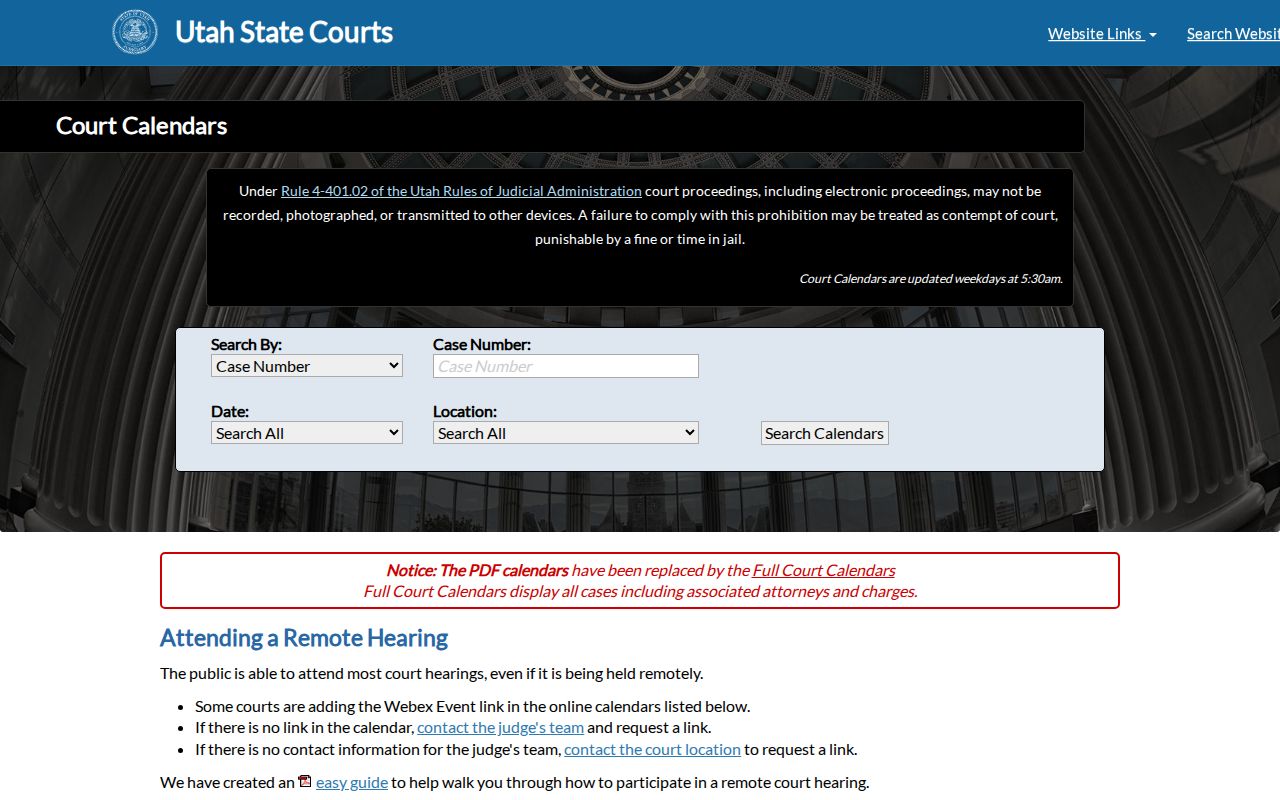
For a hearing set in the next few weeks, this Grand County calendar is the right first stop. When details conflict, follow it with a case check and a call to the clerk.
Grand County Court Date Lookups
When the stakes run high, use every channel available for a date lookup. Online data can lag. It may trail a new order. A setting that was continued can also linger in case history as if still live. Search by case number and court name, never by party name alone.
- Read the citation, notice, or filing to identify District Court or Justice Court and find the case number.
- Open the Utah Courts calendar and locate the newest date, time, judge, room, and hearing type.
- Check Xchange proceedings for a later reset or minute entry, or use MyCourtCase if you are an authorized party.
- Call District Court at 435-259-1349 or Justice Court at 435-259-1334 to resolve a conflict.
- At the courthouse, ask the correct clerk about public postings or a public Xchange terminal.
- Ask counsel or the judge's team about instructions for a remote appearance.
Need a wider lookup by name or number? The Grand County docket search lays out the statewide and courthouse routes. A written Request for a Record can pull public material, but calling beats paperwork when a hearing is imminent.
MyCourtCase and Grand County Hearings
MyCourtCase, styled MyCase in Utah Courts material, exists for authorized case participants only. It is not the public calendar. It is not paid public Xchange search. A party can review case history, filed papers, payments, and linked cases there. No account is needed just to attend a remote hearing. The official MyCourtCase explanation shows how that party-access route works.
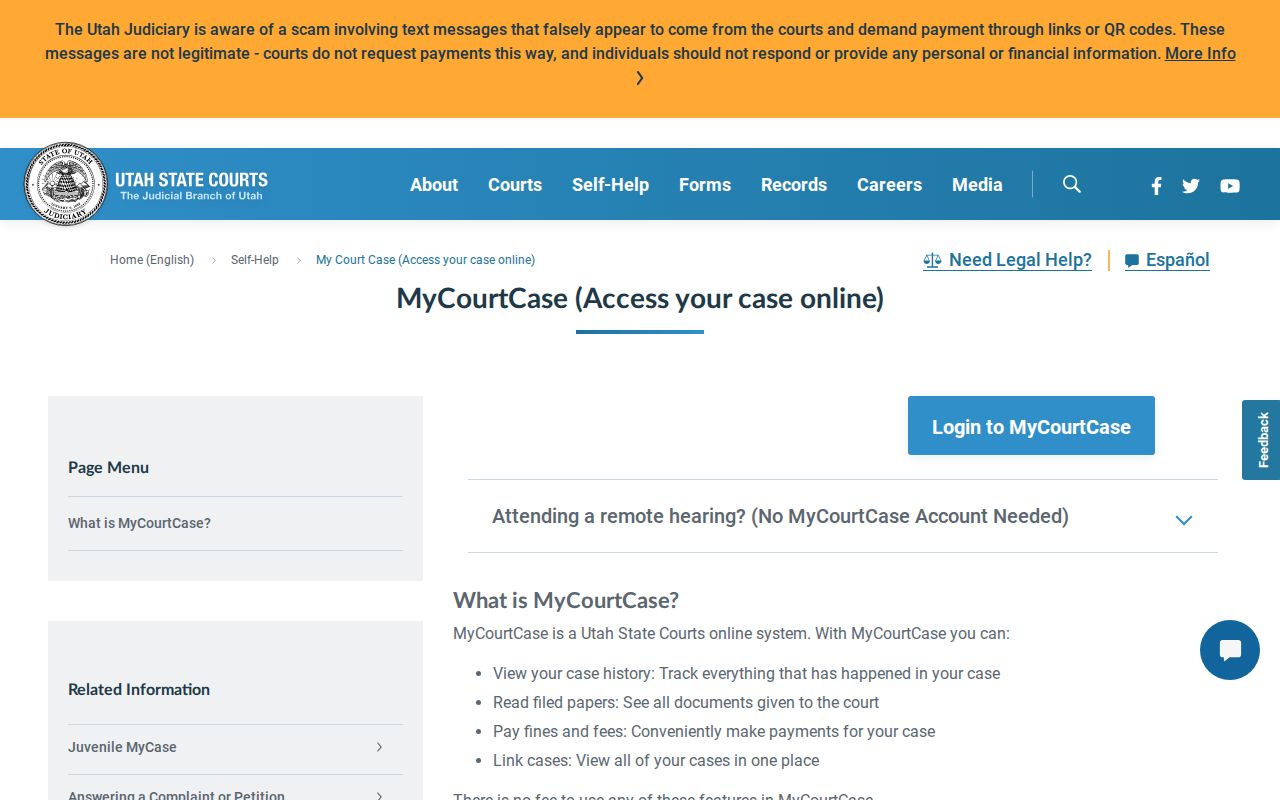
Use the account only for a case where your access is authorized. For scheduled activity open to anyone, the public calendar is still the route.
Court Settings: What Each Field Means
Read the whole setting line, not just the date. Missing court, room, or hearing type can send you to the wrong door or breed a false assumption about what happens. Utah calendar guidance backs up these fields.
| Date | The scheduled day in the current calendar window. |
|---|---|
| Time | The listed start time, which may be a docket-call time. |
| Courtroom | The room or location assigned when one is shown. |
| Judge | The judicial officer assigned to the entry. |
| Case Number | The identifier used with the court location to match the case. |
| Setting Type | The event, such as arraignment, pretrial, motion hearing, or trial. |
Party names narrow results, but names alone are not enough. Match the case number and location too. Utah case and citation numbers are not unique statewide.
Setting type shapes preparation. An arraignment is an early criminal appearance where charges and a plea may be addressed. A pretrial hearing deals with managing the case before trial. A motion hearing puts a request before the judge. None of these labels is a final outcome. Check the proceedings after the hearing for the event the clerk actually entered.
Grand County Calendar or Docket Event
A calendar setting points forward to activity that has not happened yet. A docket event records something entered in the case system, and the two often overlap without meaning the same thing. For the next appearance, trust the newest calendar entry; Xchange proceedings explain how the date came about.
| Court Calendar | Xchange Case History |
|---|---|
| Near-term, two-week schedule | Chronological case events |
| Updated daily | Updated after local CORIS entry |
| Judge, date, time, parties, and hearing type | Filings, proceedings, outcomes, and document links |
| Best for the next setting | Best for prior and later entries |
A minute entry can describe what happened without being the signed order. An old hearing event also never proves its date is still active.
When a Court Date Moves
Dates move in three ways. A reset assigns a new date. A continuance delays a proceeding. A cancellation removes a setting. Case history may keep the first date while adding a later event. Stopping at the first match is a classic mistake. Read proceedings in date order and compare them against the latest calendar.
Filing or paying by email does not change a hearing by itself. Grand County's October 2024 remote-availability order permits certain PDF filings by email. It also allows paper filings by mail or secure dropbox, plus lobby scanner use. None of those channels replaces a scheduling order. The clerk can tell you what public event stands recorded. For legal advice, turn to counsel or Utah Courts self-help resources.
Keep each date's origin clear. You might hold a mailed notice, a MyCourtCase entry, a public calendar result, and an Xchange event all at once. The most recent court-issued direction controls. When uncertainty remains, confirm directly. Save the case number before calling. Staff can then pull the right Grand County record without sorting through a common name.
Remote Grand County Court Settings
Some Utah calendar pages include a Webex Event link for joining remotely. When no link is posted, reach the judge's team or the court directly. Do not guess your way in. Appearing from home changes the setting, not the duty to show up. The Seventh District's Digital Evidence Plan and Remote Hearing Requirements took effect July 1, 2025. So follow the current instructions for any Grand County court appearance.
Check the notice. Confirm whether the hearing is in person or remote and use only the link or location supplied by the court.
For District Court scheduling questions, call 435-259-1349. Justice Court questions go to 435-259-1334 or jcmoab@utcourts.gov. A visit to the courthouse counter can also clear up a puzzling docket entry in person.
Confirming a Grand County Reset
Begin with the most recent written notice you received. Then compare the online calendar against the Xchange proceedings list. If the two disagree, phone the court that actually holds the case. Both the District Court and the Justice Court sit in one building. Yet a clerk for one court may not explain the other court's docket.
If the web display fails you, fall back on the courthouse notice board or the clerk's counter. Most district courthouses offer free public Xchange terminals. Check availability before relying on one at a justice-court location. The Grand County Clerk/Auditor shares the building address. Note that it is not the clerk of the courts.
Missed Settings and What Comes Next
Contact the responsible court right away. Ask whether the public docket shows a new setting, an order, or a warrant. A case dropping off the two-week calendar does not mean it ended. The missing date could signal a reset, a completed hearing, a restriction, or a change you have not yet decoded.
Missed a setting? A failure to appear can have serious consequences, including a warrant in some matters.
Contact District Court at 435-259-1349 or Justice Court at 435-259-1334 immediately.
Ask counsel or Utah Courts self-help resources what steps apply to your case.
Grand County traffic rules show why speed matters. An unpaid citation turns delinquent after 21 calendar days and picks up a $50 fee. Once 15 more delinquent days pass, a $75 fee is added and a warrant issues. Keep those deadlines where they belong: citations only, not civil or other criminal settings.
A civil setting, a criminal appearance, and a traffic deadline differ. Each calls for different next steps. Tell the clerk which type of matter is yours. Then ask for the most recent public event. If the clerk points to an order, get that filing and read it rather than trusting a short docket label. Anyone needing a filed copy should use the court-record request route. An urgent scheduling question belongs with the court location itself.