
Grand County Criminal Docket Searches
Utah Courts keeps one statewide home for public case information: Utah Courts Xchange. It covers both District and Justice Court records. A Grand County criminal docket search goes fastest with a case number plus the right court. Numbers are not unique across Utah. Pick Grand County or the Moab location as well. Without a number, search by Last Name/Company and First Name, and Utah Courts suggests a trailing wildcard like Doe* or John* so middle names, suffixes, and misspellings still surface.
Online searching costs money on Xchange. Every click of the Search control counts, so narrow the form first. Same-name results are common. Compare the county, court, case type, filing date, party code, and case number before assuming a match. A shared name alone proves nothing.
A Grand County Justice Court citation has a second route. The county posts a Case Search and Payment Option for looking up a ticket or citation number and paying it, though that vendor page is not the full Xchange case history. Parties with authorized access have another option for their own case. They can turn to MyCourtCase for case history, filed papers, payments, and any linked cases.
- Select District Court for a felony or qualifying Class A matter. Select Justice Court for a Class B or C misdemeanor, infraction, or local citation.
- Enter the known case number. Otherwise, use the party-name fields and wildcards, then limit the search to Grand County or Moab.
- Open the matching Case History/Documents link. Confirm the header, parties, assigned judge, charges, and filing date.
- Read Proceedings in date order, then compare the newest setting with the Utah court calendar.
- Ask the responsible clerk for a certified judgment, official recording, or public paper that the summary does not provide.
Grand County Criminal Court Split
One common local mistake is filing every criminal matter under District Court in your head. The Utah District Court holds general jurisdiction. Its Seventh Judicial District location in Moab carries Grand County felony cases plus qualifying Class A misdemeanors. The Grand County Justice Court handles the smaller stuff. That means Class B and C misdemeanors, infractions, ordinance violations, traffic and parking matters, and safety citations issued to river runners.
Whatever court is named on the citation, notice, or filing is the one that controls. An appeal out of Justice Court can open a fresh District Court proceeding. A reader tracking an appealed case may need both levels. Juvenile delinquency is different. The Seventh District Juvenile Court keeps that record restricted under separate access rules.
| Court | Grand County criminal docket scope | Direct help |
|---|---|---|
| Seventh District Court, Moab | Felonies and qualifying Class A matters | District Court clerk, 435-259-1349 |
| Grand County Justice Court | Class B and C misdemeanors, infractions, and local citations | Justice Court clerk, 435-259-1334 |
| Seventh District Juvenile Court | Juvenile delinquency and related youth matters | Restricted access through the court |
Both adult trial courts sit at 125 E. Center Street in Moab, yet each keeps its own case records.
Criminal Dockets: What They Show
The header of an extended Grand County criminal docket lists the court, case style, case number, case type, and assigned judge. Charges come before the event history. A single charge can carry a description, level, special attributes, a plea date and nature, and a disposition date and nature. Party and attorney sections spell out roles and counsel. Defendant fields may add the citing agency, officer, prosecuting agency, citation number, and violation date.
The Proceedings section runs in time order, logging the complaint or information, hearings, minute entries, pleas, orders, judgments, and other clerk-entered events. Farther down, the Account Summary works like a ledger. It tracks assessed amounts, payments, and the balance. It is not the charge narrative. It does not prove the case ended in a conviction.
| Case Number | The identifier assigned at a court location; it is not unique statewide. |
|---|---|
| Case Type | FS is State Felony, MD is Misdemeanor DUI, and MO is Other Misdemeanor. |
| Charges | Description, offense level, special attributes, plea, and disposition when entered. |
| Proceedings | The dated sequence of filings, settings, minute entries, rulings, and outcomes. |
| Account Summary | Fines, fees, revenue or trust entries, payments, and any balance. |
Grand County Criminal Docket Codes
The official Xchange case-type tables sort records by code. Reading those codes helps you tell a felony history from a misdemeanor or civil result before spending money to open more documents.
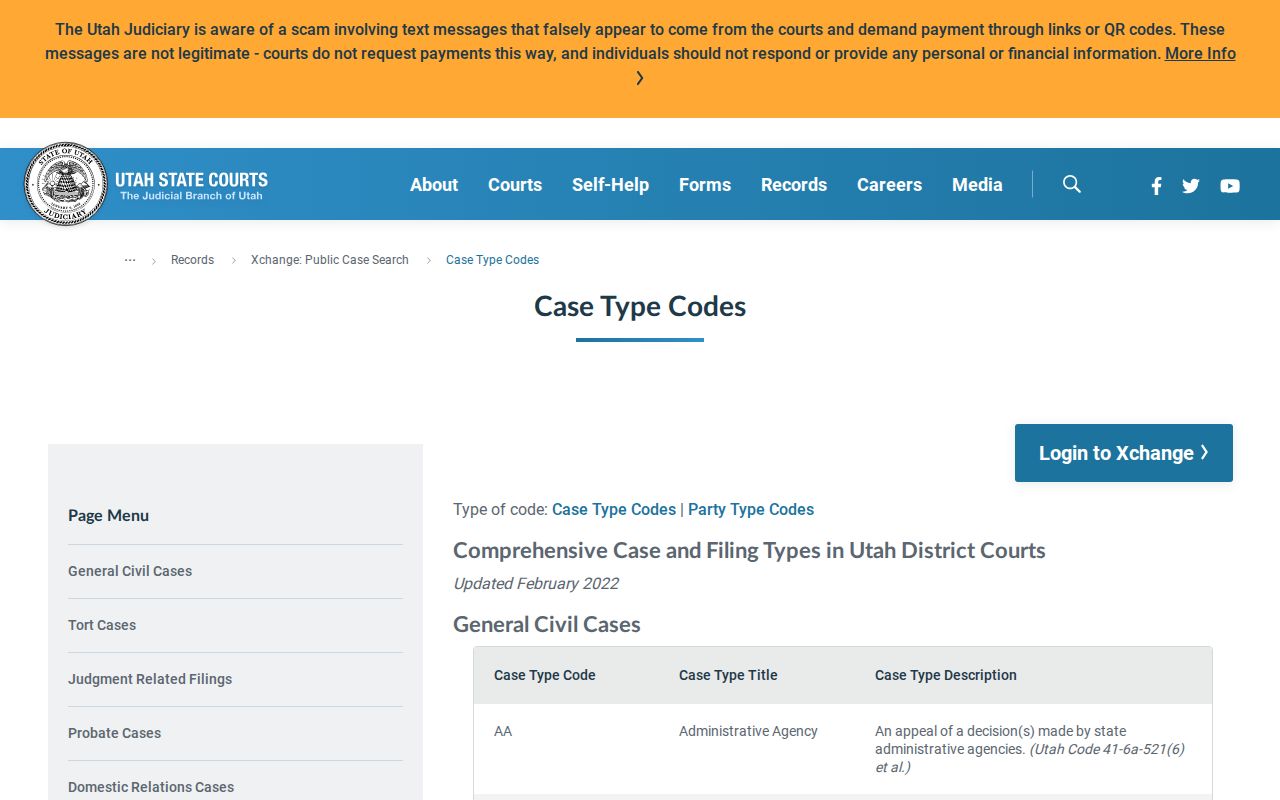
The official table gives context for the short labels appearing in Grand County search results. A code marks the filing category. It does not fix the outcome. Read the plea and disposition fields separately.
- FS
- State Felony, the Xchange category used for a felony case in District Court.
- MD
- Misdemeanor DUI, a specific criminal case category.
- MO
- Other Misdemeanor, apart from the MD category.
- Disposition
- The recorded adjudication or outcome for a charge or case.
- Minute entry
- A court entry about a proceeding or ruling, which may not be the signed order.
Criminal Case Stages on the Docket
A Grand County criminal docket builds one event at a time. The clerk records each one. The first public entry often reflects the charge filing. The arraignment entry records the early appearance and plea process. Pretrial entries may bring motions, conferences, evidence issues, and later settings. From there, a plea or trial points toward a disposition. Sentencing follows when the outcome calls for it.
Docket flow: Filing › Arraignment › Pretrial › Plea or Trial › Disposition › Sentencing
No docket line promises a uniform path. Dismissals, changed pleas, resets, appeals, and other orders can bend the sequence at any point. Grand County's Seventh District forms include a Statement of Defendant in Support of Plea(s) and Certificate of Counsel for every felony and Class A misdemeanor plea in that district. A docket event may note the plea document. The signed or filed image stays a separate record.
Dates deserve their own care. The violation date tells you when the alleged conduct occurred. The filing date marks when the court case began. A hearing date is a scheduled appearance, and the disposition date records an outcome. All four can differ.
Grand County Criminal Docket Access
Xchange is not the only channel. Free Xchange terminals wait at most Utah district courthouses, while Justice Court terminal access should be confirmed with that court. The Moab courthouse sits at 125 E. Center Street. Ask the right clerk to inspect the public case history. Inspection costs nothing. District Court answers at 435-259-1349. Justice Court answers at 435-259-1334, or by email at jcmoab@utcourts.gov.
Remote options matter in this rural district too. District Court record and scanning questions can go to moabscan@utcourts.gov. A Seventh District order issued in October 2024 lets a self-represented filer email a PDF, mail a paper pleading, use a lobby scanner, or place a pleading in the secure courthouse dropbox. The order has pleadings processed the same day. Just never leave money in the dropbox.
When a public record is missing online, start the Utah Courts Request for a Court Record process. Send the written request to the court that holds the case. The usual response target runs ten business days. Grand County's GRAMA portal serves county-held records, not court filings. It is no substitute for a court request. The county Clerk/Auditor says outright that the office is not the clerk of the courts.
Grand County Criminal Docket Courts
The Seventh District Court's Grand County/Moab office lists Loni Page as Clerk of Court. She keeps the district criminal history. The filed record behind it stays with her office as well. The Justice Court handles the lower criminal and citation docket. Its directory names Judge Danalee Welch-O'Donnal. Chief Deputy Court Clerk Emily Butterfield and Senior Court Clerk Marsha Humphreys appear there too. Their staff runs that docket daily.
The split decides where to ask for a copy. Felony judgments belong with District Court. A Class B misdemeanor judgment from Grand County Justice Court belongs with that court. Appeals change the picture. If a Justice Court judgment was appealed, Utah law hands District Court appellate jurisdiction over the new proceeding. Search the later District Court history instead of assuming the first docket picked up every appeal entry.
Grand County Treatment Court Dockets
Moab hosts a named Seventh District Adult Drug Court. The statewide Problem-Solving Courts directory also lists a Juvenile Family Dependency Drug Court in Moab.
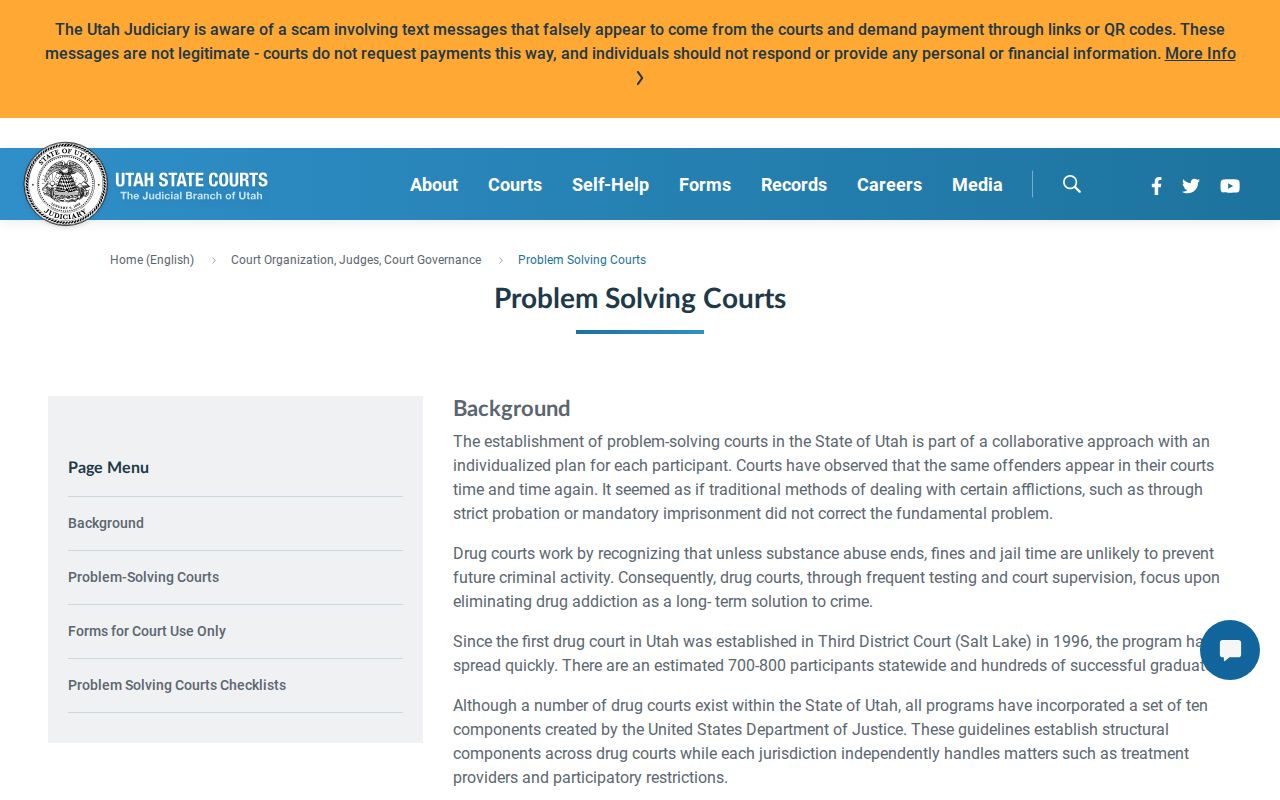
The state location table confirms a local program. Still, treatment-court records are not an ordinary open criminal list. Public District Court events appear only when classified as public. Juvenile cases, dependency matters, and clinical records can all stay unavailable. So can protected, private, or sealed items. Participants can use MyCourtCase or call the court team.
When Grand County Cases Are Missing
An empty Xchange result does not prove a case is absent. Start with the search itself. Check the court level, spelling, wildcard, county scope, and date range. Old Justice Court data may not have been fully converted. Moab District Court's statewide Xchange coverage began July 30, 1996, so earlier material can run thin. A recent filing may just await local entry.
Access rules are another cause. Sealed and expunged cases are missing from Xchange. So are juvenile delinquency, child-welfare, and termination-of-parental-rights matters. Call the responsible Grand County clerk and ask what public information can be shared. Anyone entitled to non-public material may submit the court record request with the basis for access. The clerk or judge decides access under court rules.
When a summary lists a judgment but no image, use the document Purchase link if one appears. Xchange charges $1 per available document. Certified copies cost more. Ask the clerk about the current statewide fee of $4 per document plus $0.50 per page. Official transcript or audio requests for Grand County go to moabscan@utcourts.gov.
Access Rules for Criminal Dockets
Utah court records begin with a public-access presumption. Classification controls each item. A public Grand County criminal docket may show case history, open-hearing entries, orders, and an outcome. Some things stay hidden. A protected filing, a sealed case, or victim-identifying information may not appear. The same goes for a record removed by expungement. One event line never proves its source document is open or online.
Key rules:
UCJA Rule 4-202.02 classifies Utah court records as public, private, safeguarded, protected, or sealed.
UCJA Rule 4-202.08 governs access fees, staff time, and fee-waiver provisions.
Utah GRAMA recognizes judicial records as public unless court rules, procedure, or another classification restricts them.
Never read guilt into a charge or docket event. Read the plea and disposition instead. When the result matters, obtain the signed judgment and verify it with the originating Grand County court clerk.